- Discussions/
- #264/
Omnipool liquidity strategy: reducing exposure to underperforming assets, cutting liquidity costs, and preparing for concentrated liquidity
Omnipool liquidity strategy: reducing exposure to underperforming assets, cutting liquidity costs, and preparing for concentrated liquidity
This post shares the results of a deep per-asset analysis of Omnipool performance — covering the full pool history since launch (Jan 2023) plus a detailed 90-day window (2026-05-07 → 2026-08-04) — and proposes staged actions for discussion.
The principle is simple: Omnipool liquidity is protocol capital, and it should sit in assets that earn their slot — through volume, fees, strategic role in the Hydration stack, or integration with the money market. Assets that underperform on all of these weigh on the hub asset H2O, and through it on HDX and every LP in the pool. With concentrated-liquidity pools arriving on Hydration, we also have a better home for trading pairs that don't justify Omnipool capital.
Proposed actions:
- End the aDOT liquidity-mining farm — reducing ongoing liquidity costs and Omnipool exposure to an underperforming asset
- Delist ASTR, KSM, vDOT, SUI, BNC and vASTR — the lowest-scoring assets with no strategic requirement to remain
- Continue the Omnipool strategy review as concentrated-liquidity pools launch
All figures below are derived from on-chain data (Omnipool state snapshots at daily UTC boundaries, per-asset volume aggregates, LP-position NFTs and protocolShares). Methodology notes at the end.
1. What the data shows
H2O's USD value is the pool's own health metric: every asset contributes to it in proportion to its share of hub liquidity, so underperforming listings are not free — they are carried by the hub asset, and by extension by HDX and every Omnipool LP.
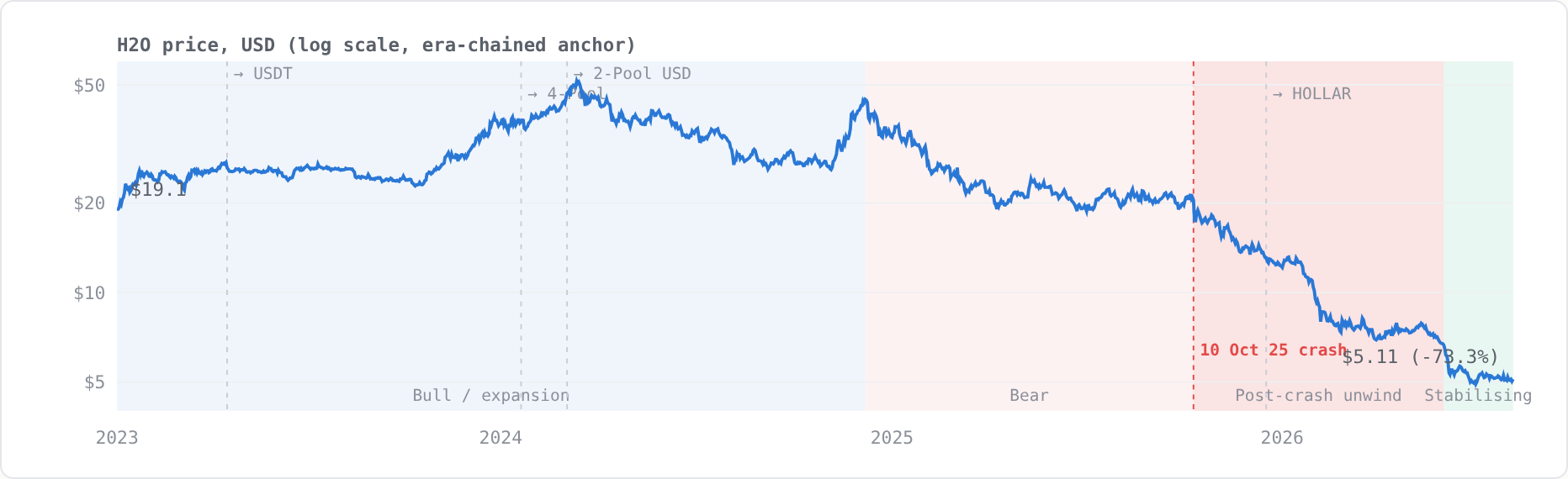
Decomposing H2O's move from its first post-launch market price ($19.12) to today ($5.11): each asset's contribution = its hub-liquidity weight × its daily price return, compounded over its listing life.
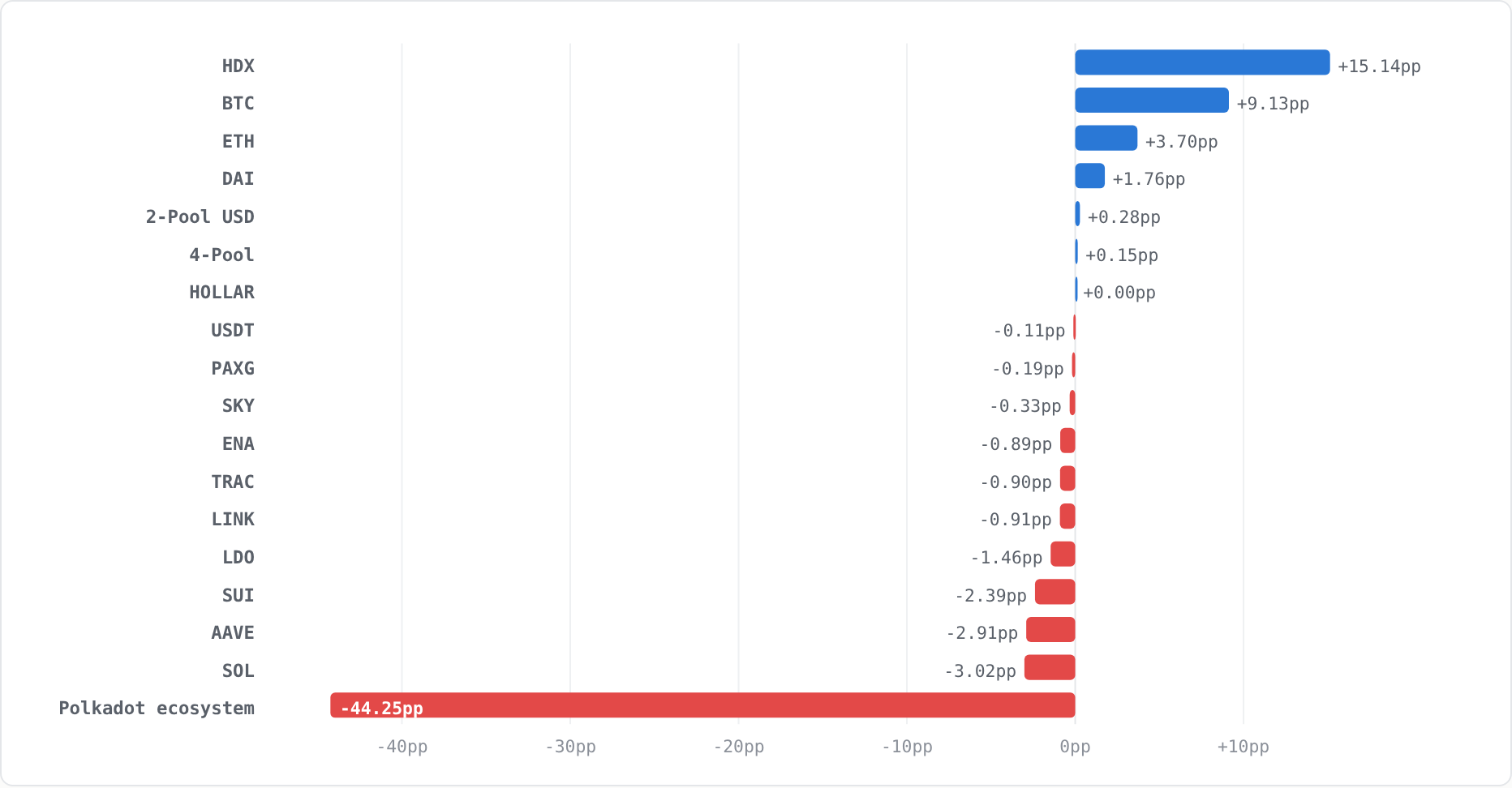
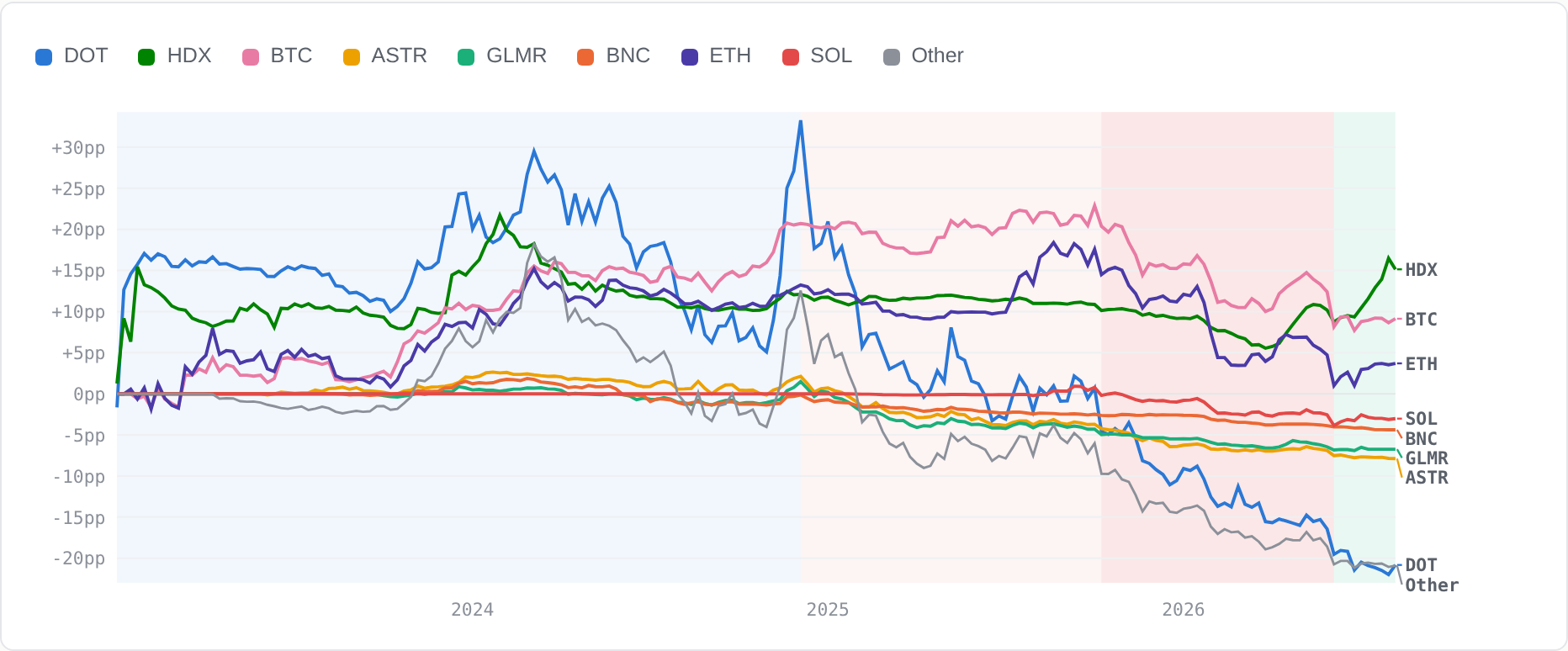
Two observations:
- The strongest contributors have been HDX (+15.1pp), BTC (+9.1pp), ETH (+3.7pp) and stables — assets with deep external markets or a core role in the Hydration stack.
- The largest negative contributions cluster in assets that combined price underperformance with sustained liquidity weight — the DOT complex (−20.8pp all-time) being the biggest single line item, with a long tail of smaller listings (GLMR −6.7, ASTR −7.9, BNC −4.4, …) that each cost more than they produced. Grouped, that cluster accounts for −44.3pp; the point is not where the assets come from, but that liquidity weight was concentrated in underperformers for long stretches.
Through 2023–2024 this mix was a positive contributor; from 2025 onward it inverted. Managing the listing set by performance is how we stop carrying that weight.
2. Which assets earn their Omnipool slot today
We score every listed asset on ten measures: 90-day volume and external LP at risk (both linear in dollars — protocol-owned liquidity is redeployable on delisting; external LP is what a delisting actually displaces), turnover, net LP yield (fees minus an impermanent-loss proxy), relative price strength, contribution to H2O, money-market integration, strategic/ecosystem factors, volume consistency, and unsubsidised activity:
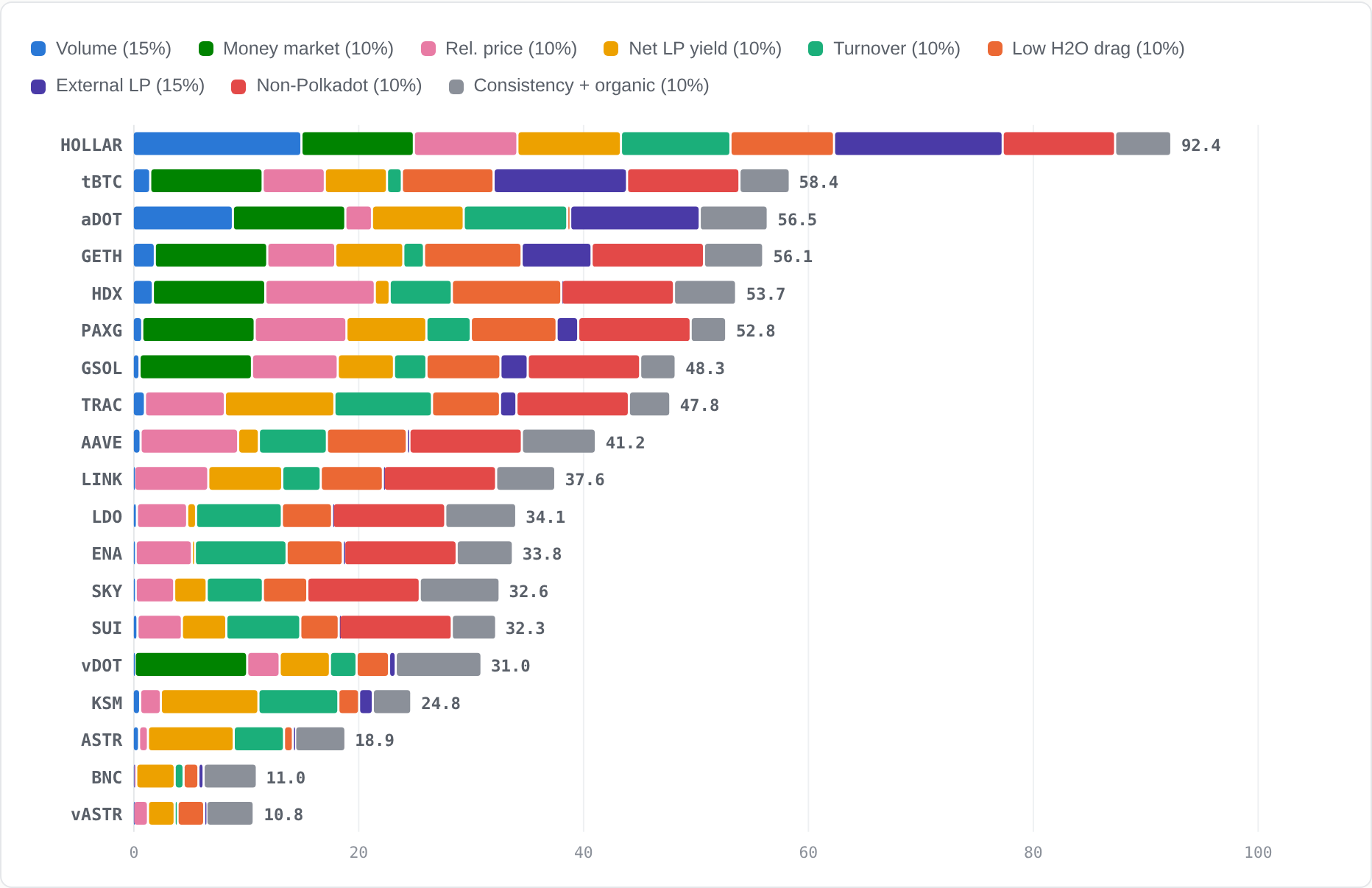
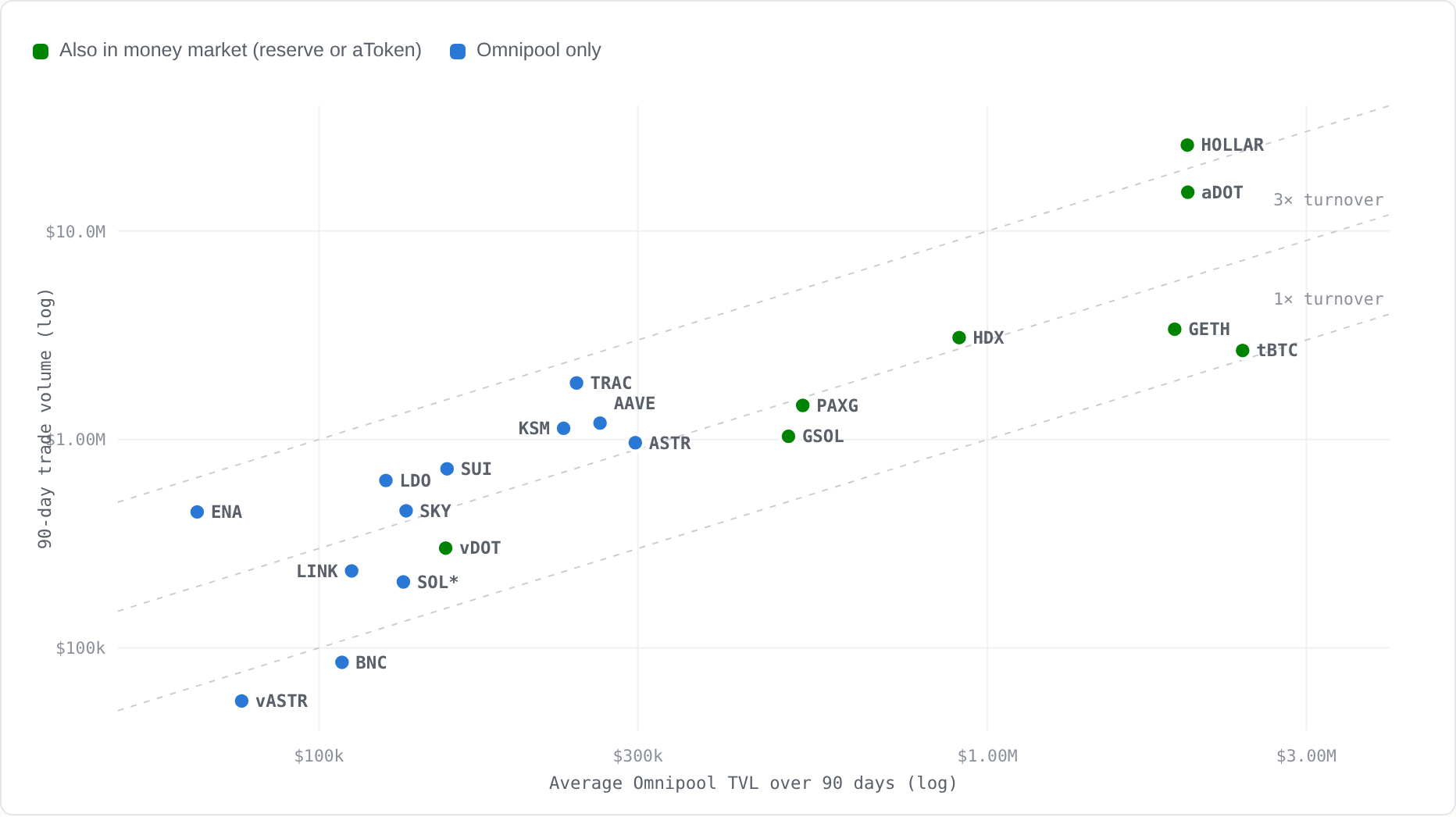
Headline window numbers: $61.2M per-asset volume against $12.7M average TVL (~4.8× pool turnover per 90d). HOLLAR (13.0×) and aDOT (7.7×) do the heavy lifting; the bottom of the table barely turns over at all.
3. Proposal 1 — end the aDOT LM farm
The aDOT farm (global farm 134, GDOT-rewarded) currently emits ~116 GDOT/day (≈ $105/day; the reward pot holds ~9,900 GDOT ≈ 85 days of remaining budget).
Ending it does two things at once: it stops an ongoing liquidity cost, and it deliberately reduces Omnipool exposure to an asset with a sustained record of underperformance — the largest single negative contributor to H2O in the pool's history. We expect a meaningful share of the farmed aDOT LP to leave when emissions stop; that is the intended outcome, not a side effect. The Polkadot Treasury's LP position, which does not farm, remains in the pool and is deemed sufficient trading liquidity for aDOT on its own. As concentrated-liquidity pools come online, aDOT trading depth has a natural second venue (see §5).
The other farms (HOLLAR, GETH, GSOL, tBTC, PAXG) are not in scope of this proposal.
4. Proposal 2 — delist ASTR, KSM, vDOT, SUI, BNC, vASTR
The six lowest-scoring assets, none of which carries a strategic requirement to stay (no money-market role, no place in the HOLLAR/GIGA stack, no meaningful fee production):
| Asset | Keep-score | 90d volume | 90d turnover | External LP displaced | Protocol liquidity freed | Note |
|---|---|---|---|---|---|---|
| SUI | 32.3 | $724k | 4.66× | $7.2k (5.5% of pool) | $125k | pool is ~95% protocol-owned |
| vDOT | 31.0 | $302k | 1.95× | $81.9k | $55.0k | exposure and liquidity already live in the GDOT stack |
| KSM | 24.8 | $1.13M | 4.87× | $168.8k | $25.2k | volume is spiky/event-driven (bottom-decile consistency) |
| ASTR | 18.9 | $965k | 3.25× | $27.9k (11.8%) | $208k | pool is ~88% protocol-owned |
| BNC | 11.0 | $85k | 0.79× | $63.7k | $17.7k | <1× turnover in 90 days |
| vASTR | 10.8 | $56k | 0.73× | $26.8k | $36.1k | <1× turnover in 90 days |
| Total | ~$376k | ~$468k |
Together these delistings displace ~$376k of external LP (≈3% of pool TVL) while freeing ~$468k of protocol liquidity for redeployment into assets and venues that earn it. vDOT deserves the explicit call-out: it is not losing its home — vDOT sits inside GDOT, which is where its liquidity and yield already live.
Delisting follows the established pattern (freeze → LP exit window → remove_token). None of these assets disappears from Hydration: they remain transferable, and every one of them has the option to trade in isolated pools or on Hydration's concentrated-liquidity pools (launching soon) where demand & infra allows.
5. Concentrated liquidity and the ongoing strategy review
Work is underway to bring Uniswap-v3-style concentrated-liquidity pools to Hydration's EVM. This is a venue upgrade for the whole protocol, not a parking lot for delisted assets: the first pairs will feature aDOT and majors such as tBTC, offering comparable tradable depth with an order of magnitude less capital, ranges chosen by LPs, and no coupling into H2O.
For Omnipool strategy this changes the calculus permanently: the Omnipool concentrates protocol capital behind the core stack — HOLLAR, HDX, the majors, the GIGA products — while concentrated-liquidity pools carry pairs on market-driven capital. Assets removed under Proposal 2, and any future removals, can trade there without protocol liquidity underwriting them.
Proposed sequence:
- End aDOT LM emissions (Proposal 1) — immediate, reversible
- Delist the six assets above (Proposal 2) — single referendum, standard delisting flow
- Continue the Omnipool strategy review as v3 pools launch and volumes migrate; further proposals (in either direction — removals or new listings) will come back to governance with the same per-asset evidence
One final chart, on why this matters for HDX itself.
HDX trades almost exclusively in the Omnipool, priced against H2O. That means every HDX holder carries two exposures at once: demand for HDX, and the performance of the pool basket behind H2O. The two can be separated exactly: HDX's USD price factors into (HDX/H2O in-pool price) × (H2O/USD), and the first term only moves when someone actually trades HDX — no other asset's flows can touch it. It is a clean record of genuine HDX demand.
The chart below re-prices that demand record as if HDX had been paired against USD from day one — same buys, same sells, H2O benchmark frozen at its launch-market value — versus the actual USD price. Both lines start at $0.00384 on 2023-01-07:
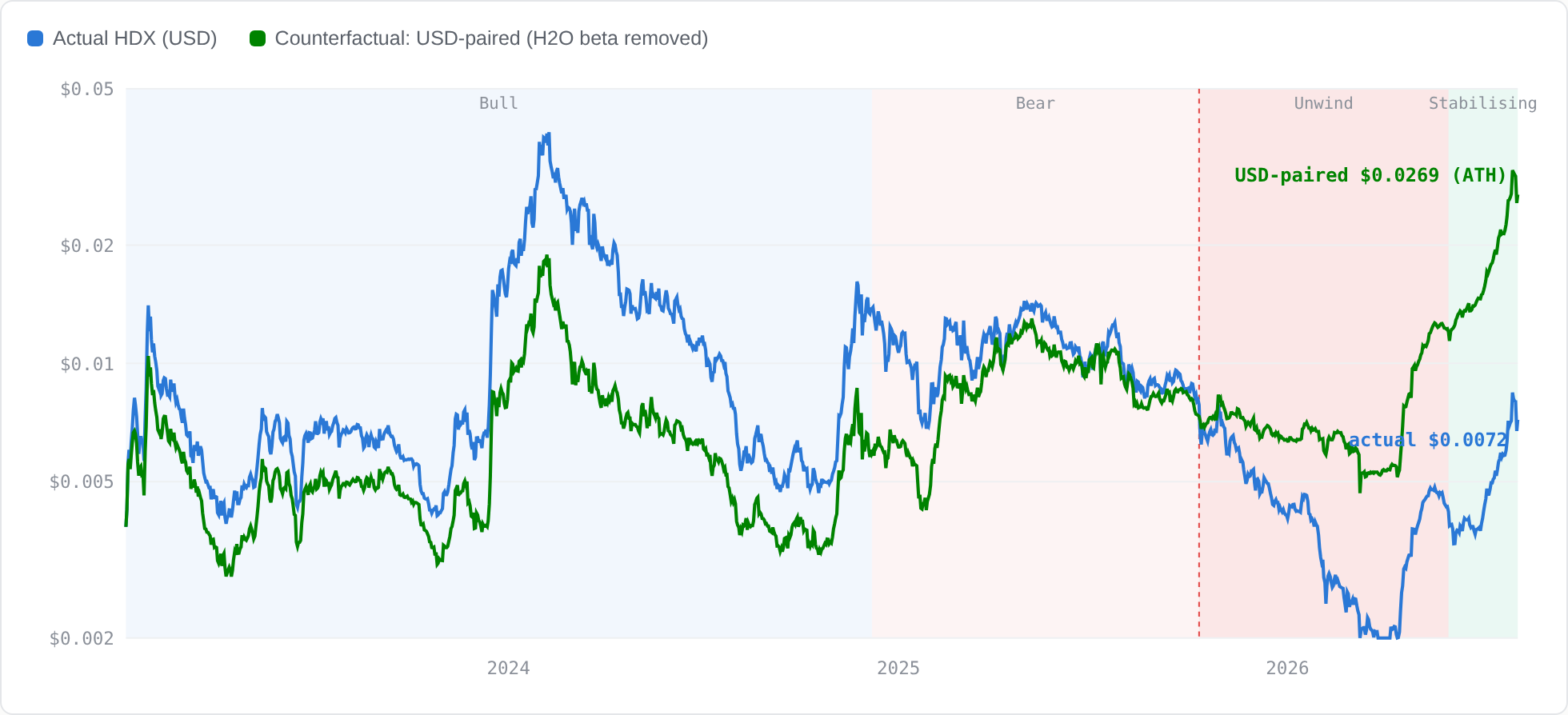
- Cumulative net demand for HDX is at its all-time high today. In H2O terms, HDX has never been more expensive. The USD-paired line ends at $0.0269 — against an actual price of $0.0072. That 3.7× gap is the cost of the basket documented in the analysis above.
- From launch: +601% on HDX's own demand versus +87% actual.
- The split by period is instructive: during 2023–24 the H2O pairing amplified HDX's rally (the blue line ran ~2× ahead of demand). Since 2025 the same coupling has worked in reverse — and notably, through the entire post-crash unwind the demand line barely moved: the drawdown in HDX was almost entirely basket, not HDX selling.
Usual caveats: this is a thought experiment, not a simulation — pool depth and trader behaviour would differ in a genuine USD pairing, and the 2024 boost would likely have been smaller too. But the direction and scale of the effect are exactly why the proposals above focus Omnipool capital on assets that pull H2O up rather than down: every point of H2O performance recovered accrues directly to HDX and to every LP in the pool.
Methodology
- Per-asset Omnipool state and volumes from the Hydration unified indexer at daily UTC-midnight block boundaries since launch (block 1,708,101); USD prices derived from pool hub-reserve ratios, era-chained through the in-pool stable of the day (DAI → USDT → 4-Pool → 2-Pool USD, NAV-corrected → HOLLAR), validated against external market history (e.g. DOT $11.38 at the Mar-2024 peak) and, in the HOLLAR era, accurate to within 0.7% of the direct anchor.
- Ownership split from on-chain
protocolSharesplus the Treasury's LP-position NFTs (pro-rata by shares, block ~13.46M). Farm data fromomnipoolWarehouseLMstorage including reward-pot balances (unfunded "Active" farms treated as not distributing). - H2O contribution figures are hub-weight × daily log-return, compounded; the residual (flows, LRNA mint/burn, fees) is reported separately and not attributed to any asset.
- Happy to share the full interactive report and reproduction queries with anyone who wants to dig in.
Feedback welcome — particularly on the delisting set, the aDOT farm timing, and what you'd want the strategy review to evaluate next.
Edited
Reply
Up
Comments